
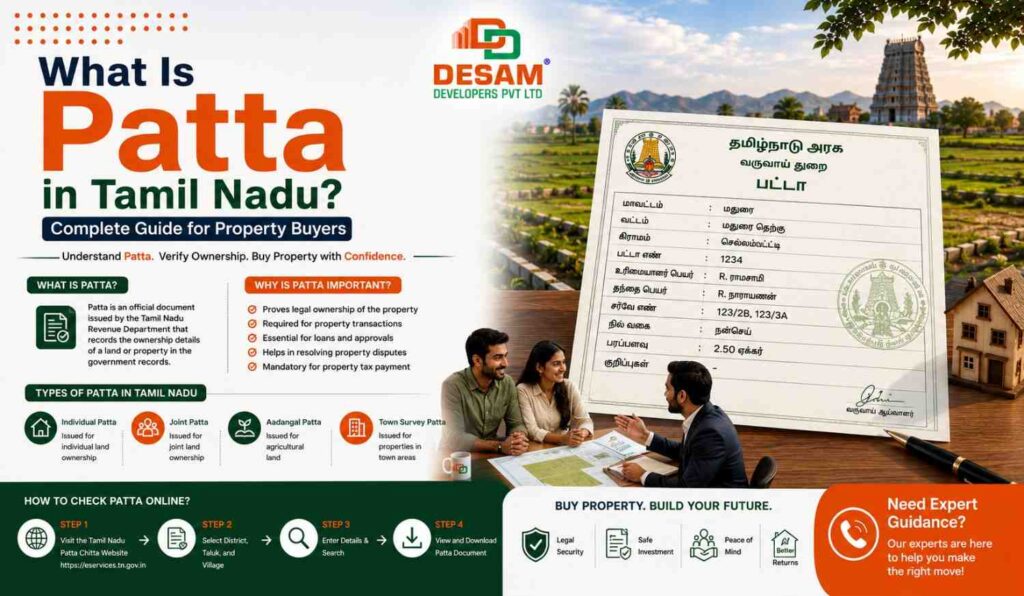
If you’ve started looking at plots or land in Tamil Nadu, you’ve almost certainly come across the word “Patta.” It’s mentioned in nearly every property listing, every document checklist, and every conversation with a broker — but few buyers actually understand what it means, why it matters, or how to check it themselves. This guide breaks it down completely.
What is Patta? A Simple Definition
Patta is a legal land ownership document issued by the Tamil Nadu Revenue Department, officially recording an individual as the recognized owner of a specific piece of land in government records. In simple terms, it’s the government’s official acknowledgment of who owns a plot — separate from, but closely tied to, the registered sale deed.
Patta vs Chitta vs Adangal — What’s the Difference?
These three terms are often used together, which causes confusion:
- Patta — confirms ownership of the land as per revenue records.
- Chitta — indicates the land’s classification (agricultural or non-agricultural, i.e., “natham” or “nanjai/punjai”).
- Adangal — a detailed record showing crop history and land-use details, mainly relevant for agricultural land.
For a residential plot purchase, Patta and Chitta are the two documents you’ll deal with most directly.
Types of Patta in Tamil Nadu
1. Single Patta
Issued when one individual is the sole recognized owner of the land. This is the simplest and most straightforward type for a buyer to deal with.
2. Joint Patta
Issued when two or more individuals jointly own the land — common in cases of inherited property shared among family members. Buying land under joint patta requires consent and signatures from all listed owners.
3. Combined Patta
Covers multiple survey numbers or plots owned by the same individual, combined into a single patta document for administrative convenience.
Why Patta Matters When Buying Property
A valid, updated patta in the seller’s name confirms that the government revenue records match the person selling you the land. Without it, even a registered sale deed can run into complications — banks may refuse loans, and future resale can become difficult if the patta hasn’t been properly transferred through each ownership change.
How to Verify Patta Online in Tamil Nadu
- Visit the official Tamil Nadu e-Services portal for land records (Patta Chitta services).
- Select the district, taluk, and village where the land is located.
- Enter the survey number or the owner’s name to search.
- Cross-check the name, extent (area), and classification shown online against the physical patta copy provided by the seller.
Always verify this independently rather than relying solely on a photocopy handed to you.
How Patta Transfer Works?
When a property changes hands, the patta must be formally transferred to the new owner’s name at the local Taluk office, following registration of the sale deed. This typically requires the registered sale deed, an application form, and supporting identity documents. Until this transfer is complete, government records may still reflect the previous owner — so buyers should always confirm this step has been completed, not just promised.
Common Patta-Related Issues to Watch Out For
- Patta still in a previous owner’s name, despite the sale deed being registered
- Mismatch between the patta’s extent (area) and the actual plot boundaries
- Joint patta land being sold without consent from all co-owners
- Chitta classification showing agricultural land being sold for residential/building purposes without proper conversion
Buy Patta-Verified Plots with Desam Developers
At Fair Land, Ayyankotai, every plot comes with a clear, verified patta and chitta, alongside full DTCP approval, so buyers never have to navigate this process alone or worry about mismatched records. Desam Developers Pvt Ltd handles this verification transparently, giving families confidence from day one.
 Contact 92 4000 4000 Desam Developers Pvt Ltd today for patta-verified, DTCP-approved plots
Conclusion
Patta might just look like one more document in a long checklist, but it’s one of the most important pieces of proof that the land you’re buying is legally clean and properly recorded. Understand it, verify it online, and never skip confirming that it’s been transferred to the seller’s name before you buy.
For the complete document checklist beyond just patta, read our companion guides: “How to Verify Plot Documents in Tamil Nadu“ and “What Documents Should You Check Before Buying a Plot in Tamil Nadu?“